Minggu, 15 Mei 2011

Cannabis and Psychosis

One of the best things about my blogging gig over at Psychology Today is that I've now attracted the attention of more researchers in the field from all over the world.  I'm a clinician doing my work in a suburb of Boston - I know some pretty cool and important people who make amazing research contributions, but I am certainly not among them.   Most of my musings here at Evolutionary Psychiatry are theoretical - there are NO paleo 2.0 diet trials for any psychiatric condition, after all.  If someone walks into my clinic with bipolar disorder, I can't say "oh, just try a ketogenic diet and a multimineral and you will be fine."  There are no trials and case studies of ketogenic diets in the literature were failures.

That doesn't mean I don't push for elimination of food toxins, put in a little plug for pasture butter, demonstrate and encourage stress reduction techniques, focus on good sleep hygiene (and look for sleep disturbance and medical causes), and I do take people off statins when there is good clinical reason (primarily in folks with dementia, with good results, actually.  Also, a couple of cases of resistant depression.) But I can't go full-blown evolutionary psychiatry with all my patients.  Some aren't interested, and for others the data isn't there.  Which is okay.  EvPsych has reinvigorated my interest in the field and in research, and I feel the preventative potential of a paleo 2.0 diet is amazing - so for subclinical disease, I feel my blog and the diet are likely doing a lot of good, far more good than I could do in the time I have to see patients one by one.   But I don't have any proof of that.  Which is okay.  I'll still keep looking for more evidence and more nutritional links.

But!  Cannabis!  I am honored that my twitter feed (warning - I might tweet about Crossfit, shampoo, and my children) is followed by Dr. Sanjuan in Spain, who sent me a link to this article, which among other articles will be the anchor for this post.

Cannabis.  Evo Med is the province of rebels, and rebels love pot...

Pot might not love you.

Cannabis is the world's most popular recreational drug and its use has accelerated among adolescents in the United States.

There are two circumstances in which I tend to see heavy pot use - young people struggling with psychotic disorders, and older folks with lifetime heavy pot use struggling with cognitive function and anxiety problems.  Such circumstances are weighted to bias my opinion against pot as the happy self-medication of choice.  You are forewarned!

Cannabis use has a high comorbidity with populations with psychotic disorders.  Its continued use is associated with poor outcomes in psychosis and with more frequent and earlier relapses (1).    Use has been associated as a risk factor for emerging psychosis, and a young person with heavy use will have a two-fold risk of developing psychosis (2)(3).  The earlier the age at which cannabis is first consumed, the greater the risk.

So, what might cannabis do that would cause psychosis in vulnerable individuals?  THC will stimulate the cannabinoid receptors type 1 (CB1-R) , which are abundant in the cerebral cortex, particularly the frontal regions. basal ganglia, hippocampus, anterior cingular cortex and cerebellum.   All of these areas can play a role in the neural circuitry of psychosis, and animal studies have implicated cannabis as a causative agent in the psychosis hotspot of the mesolimbic area.

Only a small proportion of cannabis users develop psychosis, suggesting there are genetic forces at play.  The primary effect of endocannabinoid activation is the modulation of neurotransmitter release in the mesolimbic area.  Animal studies also suggest that exogenous cannabinoids like THC affect dopaminergic transmission in the prefrontal cortex and the mesolimbic pathway (the areas affected by schizophrenia).

Let's examine COMT.  This enzyme sits in the synapse and will break down dopamine, norepinephrine, and epinephrine.  There is a common polymorphism of the COMT gene - folks with the valine allele of the COMT gene will have higher COMT function than those with the methionine allele.  Increased COMT activity may result in a combination of reduced dopamine transmission in the prefrontal cortex  and increased dopamine mesolimbic signaling - this combination is higher risk in schizophrenia, which presents with decreased executive functioning and working memory combined with risk of experiencing delusions and hallucinations.

Adolescents carrying the Val allele of the COMT gene are more at risk for schizophrenia in the Caspi research - the Sanjuan research found that those with the Met allele were more at risk.  Other studies of cannabis use suggest that those with psychosis are more likely to use cannabis, and more likely to use the high-potency cannabis called "skunk."

That's all well and good.  Repeated used of a cannabinoid agonist (POT) will produce prolonged and repeated use of the cannabinoid receptor.  This will result in hunger, a bit of paranoia, psychosis, euphoria, cognitive impairment, and pain relief, and withdrawal effects of increased pain and anxiety.

So, does cannabis use increase the risk of schizophrenia use or what?  Well, all the studies are observational, and it is pretty clear that those at risk for psychosis (with prodromal symptoms and high genetic risk) will tend to use more cannabis.   However, the strongest evidence against a causative effect of cannabis is from native populations who regularly use cannabis, and in which there is no increased risk of psychosis.  Your risk will depend upon your genes and experience- but I am not a fan.
Read More..

Sabtu, 14 Mei 2011

At long last!  Between Blogger going kaput for a couple of days and the usual stuff, my inositol post had to wait a bit.  I'm sure more people are interested in cannabis, but those are a few days away, assuming I don't get distracted by something else along the way (as is so often the case).

Anyway, the research team at Massachusetts General Hospital (I attended some of their meetings when I was a resident) just published a good paper in the Journal of Affective Disorders: Second-tier natural antidepressants: Review and critique.  This paper goes over R. rosea, chromium, 5-HTP, and inositol, but I'm going to start with inositol, as I could use some second messaging review myself, and I looked it up specifically for a patient as well.  Even though we are talking "natural" supplements here I still don't contend this is "evolutionary" psychiatry - none of our ancestors were chugging vats of inositol so far as I know - but figuring out how these things work helps us to understand biochemistry and speculate as to what could be going on that we might end up with an inositol deficiency, as it were.

First off - let's just mention the "first tier" natural antidepressants and complementary medicine treatments.  That is, stuff generally considered "herbals" or "alternative medicine" that has a solid evidence base in the scientific literature.  (I'm using the "quotes" because I don't see the need to distinguish these things so much - is there evidence base or not?  I don't care if someone thinks meditation is flakey or "new age" - does it work?  It certainly can!  With life-changing results.  Off my high horse).  The well-studied "herbals" with a "growing consensus of antidepressant effectiveness and safety" include St. John's Wort*, SAMe, and omega-3 fatty acids.   Folate, acupuncture, and exercise are other alternative treatments that have some studies of efficacy as antidepressants.

So, inositol doesn't have as much evidence base as any of the treatments in the previous paragraph, but we'll talk about what it is, and the evidence we have. (SAMe has shown efficacy in at least 20 trials over the years, some larger than others, some better controlled than others, so it is my "favorite" alternative treatment - but it can cause mania, and unless your folate cycle is humming along, can become evil homocysteine, so be warned).

So - inositol is a sugar alcohol and an isomer of glucose, and its 9 varieties are found mostly within cell membranes.  Myo-inositol is the most abundant stereoisomer, making up 95% of the total free inositol in the body.  Humans generally consume about a gram of inositol a day, and it is abundant in grains, beans, nuts, and fruits.  (You might not be surprised to know the best sources are organ meats - beef heart and liver, but also wheat germ - but, uh oh - wouldn't the phytic acid in wheat germ bind up inositol - well, inositol is a part of phytic acid, which we can't actually break down, so, typically, animal sources will be more bioavailable than the phytate plant sources of inositol.)  However, I ain't gonna lie - we can make inositol from glucose, and there's no evidence that we have a limited capacity to make inositol so that a dietary deficiency may not matter.  We eat maybe a gram a day, and our kidneys make about 2 grams a day.  Inositol is sometimes called "Vitamin B8."

So what does inositol do in the human body?  Well, tons of things, actually.  It is a key part of the second messenger system.  Que?  Well, in the pony express line that is a cell, surface proteins and receptor complexes (the mailer) hand off signals to the second messengers (the riders on the ponies) who pass the signal along eventually to other cell systems (the message recipients), such as the nucleus.  All the major neurotransmitter systems use inositol as part of their messaging line - I'm talking dopamine, norepinephrine, serotonin, acetylcholine� "The potential importance of inositol in psychiatric disorders is thereby evident when one considers the number of receptor types/subtypes that interact with this signal transduction pathway."

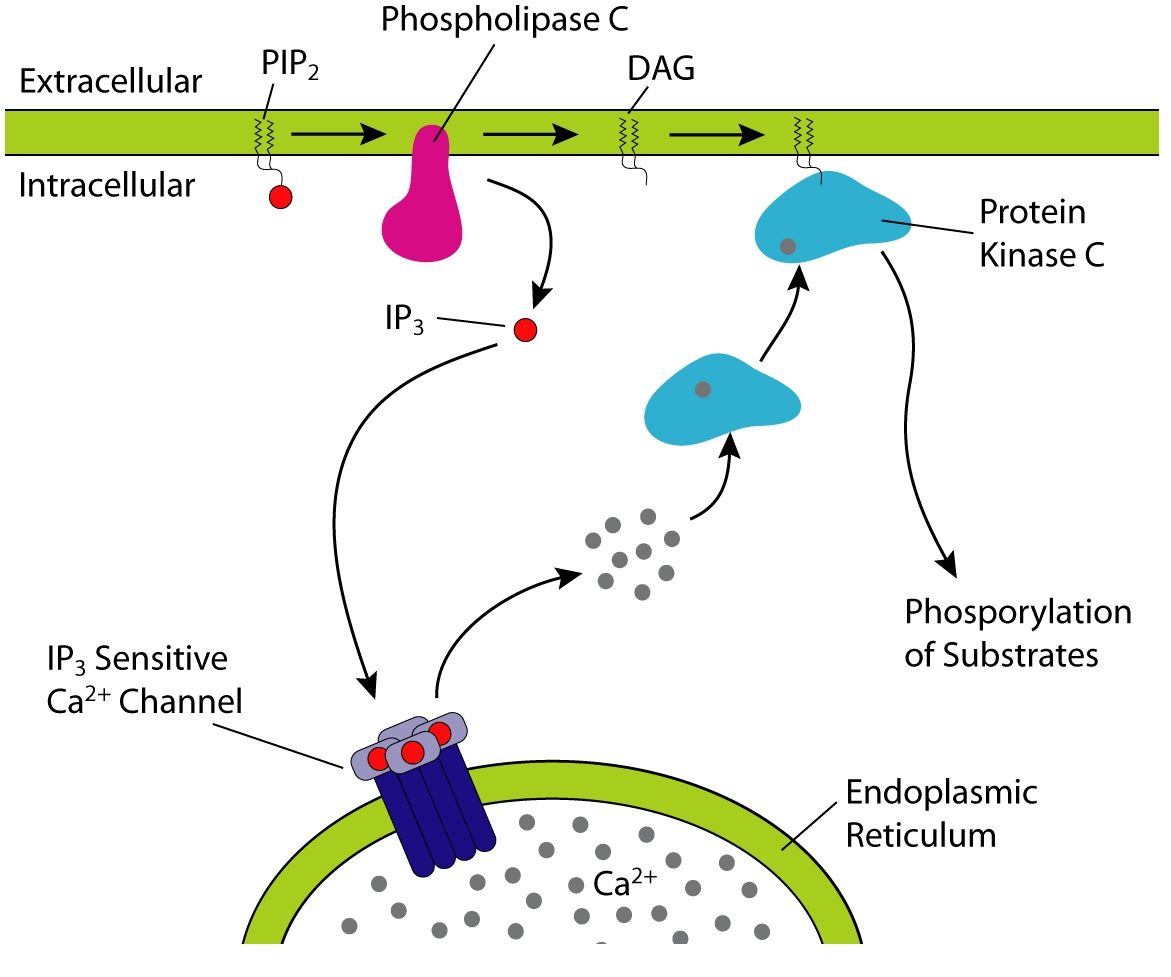
Biochem nerds will already know this next bit, but biochem nerd wanna-be's listen up (the rest of you can skip to after the picture, because this bit is a little dry) => Inositol is used to make inositol triphosphate (IP3) and diacylglycerol (DAG).  IP3 binds IP3 receptors, particularly calcium channels in the endoplasmic reticulum, which will cause calcium levels in the cytoplasm to increase, causing a cascade of intracellular activity.  Calcium and DAG can activate protein kinase C, which (as all kinases do) goes around sticking phosphates on things, leading to altered activity. Anyone learning molecular biology and biochemistry will see this pathway mentioned so many times your eyeballs will glaze over.  So, in short, inositol is vital.

Picture! (from wikipedia):


There has been discussion in the comments on my lithium posts about lithium interfering with inositol metabolism - specifically it interferes with inositol monophosphatase possibly leading to reduced recycling of inositol and IP3 in the cell and reduced inositol levels (1) however - it is unclear that the actual end product is a reduction of second messenging or something else.  One theory of bipolar disorder is that it is caused by "hyperkinetic second messenger systems." This imaging study seems to confirm that something screwy is going on with second messenger systems in bipolar disorder, but no one is sure yet what the heck it all means.  By this same theory, the "depression" side of bipolar disorder might result from a reduction of inositol after the manic episodes, and depressive disorders might result from reduced signaling in the first place, leading to inefficient cell energetics, mechanics, and build-up of toxic calcium in the wrong places at the wrong times.  Sounds nasty.

Ready for the clinical data (ie the really interesting and more practical stuff)??   A study back in 1978 found decreased inositol levels in the spinal fluid of depressed patients.  However, subsequent studies didn't replicate the finding, and that levels of inositol in the spinal fluid didn't predict response to inositol. But post-mortem examination of suicide victims have shown lowered myo-inositol levels, and magnetic resonance spectroscopy showed reduced myo-inositol levels in the frontal lobes of bipolar and unipolar depressed patients.  Dietary administration has been shown to increase inositol concentration within the central nervous system in humans (2).

But does it work?  In the comments, more than once people have mentioned taking inositol 750mg several times a day with good effect.  Well, there are a number of trials, some controlled, some open-label.  In the trials, an average dose was 12 GRAMS a day (which would be 16 of those 750mg capsules - divided 2-4 times a day - which would mean you would go through this bottle in a little over six days, putting the monthly cost minus shipping at about $34� inositol is also available as a powder which seems like it could be a bit more cost-effective for the "prescription" doses studied).  Some trials showed no benefit, but others showed no improvement at 2 weeks, but a definite improvement at 4 weeks.  Trials (as an adjunctive treatment, meaning with mood stabilizers) in bipolar depression were a little more promising.  One patient did develop mania after 24 weeks on inositol.  Most of these studies were done on people who did not respond to traditional antidepressants, and so even a modest effect is promising, as so-called "treatment resistant" patients tend to be "treatment resistant" to all kinds of interventions.  Additional studies (typically using even more inositol - 18 grams a day) had positive results for anxiety, bulimia, and obsessive compulsive disorder.  Inositol seems to act on these disorders a bit like nature's SSRI.

What is inositol's downside (besides needing to take mountains of it) - side effects in these trials included mild increases in plasma glucose, gas, nausea, sleepiness, insomnia, dizziness, and headache, and then there are the case reports of mania (any antidepressant, including light therapy, can cause mania in vulnerable people.)  No one dropped out of the trials due to side effects from inositol.  Inositol does not appear to have any drug-drug interactions - however, it might induce uterine contractions in pregnant women, so should not be used in pregnancy (3).

In the end, inositol might be helpful for some people, and it would be interesting to see if the organ-meat eating paleos have higher inositol levels in the CNS than your average grain eater.  But you'd have to eat a lot of beef heart to reach 12 grams daily.

*about St. John's Wort - product studies I have seen in the past suggest you are unlikely to get standard doses or product in SJW off the shelf, also it is most probably an MAOI and definitely has major drug interactions, such as with birth control pills and coumadin - SJW is not a product I routinely recommend for those reasons - BUT in the RCTs of pharmaceutical grade - one of which was done by this same Massachusetts General Hospital research group-  it worked as well as prescription antidepressants.  Chris Kresser suggests that this is because they all work as well as placebo.  Personally I think from reviews of published and unpublished studies prescription antidepressants give you a 10% advantage over placebo in the short term and likely work better in the long term, but they are a pain in many ways, have side effects, and the long-term effects are generally unknown� my favorite source for unbiased evidenced-based information on psychiatric meds is Dr. Daniel Carlat his team at The Carlat Report.  He has a great blog focused on industry influence and sniffing out misleading information but it is geared more toward psychiatrists than the layperson.
Read More..

Rabu, 11 Mei 2011

Couple Things...

I have some more refurbished posts up on Psychology Today - some are updated, and/or combined posts, and a couple of them have some pretty intense information that deserves a refresher even if you have read it before ;-)

Autism and Ketogenic Diets

ADHD and Mom's Serotonin Deficiency

Sunlight, Sugar, and Serotonin

Also, a big thanks to the lovely people at the British Journal of Psychiatry, who have granted me persmission to use their graph in my Season of Birth and Anorexia Nervosa post from the end of last month. 

As for new stuff, I'll likely have a post on inositol (and its uses for depression) up in the next day or two, followed by some cannabis posts. 

Happy Wednesday!
Read More..

Sabtu, 07 Mei 2011

Back in 2003, Avshalom Caspi published a paper in Science that rocked everyone's world (at least in psychiatry): Influence of Life Stress on Depression: Moderation by a Polymorphism in the 5-HTT Gene.

I know that doesn't sound all that exciting, but everyone who is anyone will pull a graph from this 4-page seminal Caspi work and ooh and aww over it. In fact, as of this week, the article has been cited by 2022 other articles. This paper links nature and nurture and depression in one elegant demonstration - so without further ado�

Caspi used subjects from a lifelong observational study, the white New Zealanders known as the Dunedin Multidisciplinary Health and Development Study. This cohort of 1037 children was studied at ages 3,5,7,9,11,13,15, 18, and 21, and 96% of the subjects could still be found at the age of 26. This careful observation meant that Caspi could not only rely on the lifelong memories of the subjects about history of trauma and medical/depressive issues (which can be to some extent unreliable), but also what was studied at all the data points in the subject's lives.

847 members of the cohort were divided into three groups based on 5-HTTLPR genotype - l/l, s/s, and s/l. No need to scratch your head - let me explain!

Basically, we are talking serotonin here. Serotonin is an important neurotransmitter in regulating our emotional state. Like any neurotransmitter, serotonin is made by one neuron, which then spits it out into the synapse in between neurons. Then the serotonin floats over to the second neuron and activates the receptors over there. On the first neuron, there is a serotonin reuptake transporter that sucks serotonin back into the first neuron to be recycled and used again. See the picture below:

Image Credit

So peer at that reuptake transporter (yellow) and have a look. All of us have genes that code for the making of that transporter. And this gene happens to have a special promoter (called the 5HTTLPR) that directs how much serotonin reuptake transporter we make. People (and rhesus monkeys, as it happens) that have two LONG (l/l) copies of the promoter have higher levels of serotonin in the spinal fluid. People (and monkeys) with two SHORT (s/s) copies of the promoter have lower levels of serotonin in the spinal fluid. People with a short and a long (s/l) are, predictably, intermediate. Got it? Serotonin-speaking, s/s is the short end of the stick, s/l is in the middle, and l/l is protective.

Back to New Zealand, where it was found that 17% of the young adults in the Dunedin cohort were s/s, 51% were s/l, and 31% were l/l. Caspi and his crew collected information about previous depressive episodes, suicide attempts, previous traumatic events (employment, financial, housing, health, and relationship stressors), and current psychological state. It turns out that when you look at current or previous depression or suicide attempts, the link between the type of promoter you have and those findings are non-significant. Uh oh. That sounds like a big bust! The type of serotonin transporter gene promoter you have doesn't seem to matter�

Then Caspi's team ran the numbers backwards and forwards, plugged in number of stressful life events and generated this remarkable finding:


As you can see, if you've had no stressful life events, your likelihood of having a depressive episode is around 10%. If you have the protective l/l version of the promoter, even if you have 4+ major stressful events, your chance of having a depressive episode only climbs a little. But if you have the s/s "short end of the stick" promoter, add stress and your risk of developing depression climbs very quickly. When you plug in severe childhood maltreatment as a variable, the s/s folks have a 63% chance of having a major depressive episode by age 26. The l/l severely maltreated children had a 30% risk of having a major depressive episode by age 26. The s/s folks with 4 or more stressful life events accounted for only 10% of the cohort, but 23% of the cases of diagnosed depression in the cohort.

So what we have found here is that this particular genetic lottery can tell us to some extent which of us are more resilient to stress, and which of us are less so, at least with respect to depressive episodes and suicide attempts (plotting suicide attempts against number of stressful life events generates a similar graph). These percentages (roughly 20% s/s, 50% s/l, and 30% l/l) are pretty much the same as those in Europe and America. The yearly incidence of Major Depressive Disorder is right around 20% too, by the way.

We've learned also that trauma changes our brain. Years later, if we have endured trauma, we are more vulnerable to having a major depressive episode and to make suicide attempts, modulated in part by how many serotonin reuptake transporters we have.

How does trauma change the brain? Our genes are pretty much set in stone from the moment 23 chromosomes from Mama meet 23 from Dada (except for random mutations). However, gene expression can change throughout life (and over generations). How does that happen? Well, that's (in part) what we mean by the word epigenetics.

A lot of our DNA spends its life wrapped up like candy. Proteins called histones wrap around the DNA and prevent it from being transcribed into RNA (RNA is the stuff that is eventually translated into proteins). Histone wrapping is entirely necessary - after all, all of our cells (except sperm and eggs) have the same DNA, and yet it is patently obvious that a skin cell is quite different from an eyeball cell which is different than a neuron. So in some cells, certain DNA is expressed, but not in other cells.

Histones that are highly methylated hang on tight to the DNA and keep it from being transcribed. Once you demethylate the histones, the DNA is set free to be expressed. A practical example - certain species of rodents called voles have species that have very attentive mothers, and less attentive mothers. The baby voles raised by the less attentive mothers seem to be more vulnerable to stress later in life. But put a less attentive species vole with a high attentive species mother, and the baby vole grows up resilient to stress. Decreased methylation of the attentive (oxytocin) gene results in a genetically inattentive vole becoming more like an attentive vole.

Y'all remember Lamarck, right? He's the guy who postulated that giraffe's necks got all long because they stretched them to reach the high leaves, and the stretchiness-length was passed on to baby giraffes. Well, it turns out that in some respect, Lamarck had it right - what we do, what we eat, what we experience, how we cope - all of these things can affect the expression of our DNA. So Lamarck gets the last laugh - to some extent. You want to change those brown eyes blue - don't wait for Lamarck - get some contacts. And don't expect the kids to inherit the faux color.

And so at last we come around to Evolutionary Psychiatry. Our gene expression has been modulated by selection pressure for thousands and thousands of human generations. Live and eat and sleep more like a hunter-gatherer, and it seems to me you are more likely to deactivate the histones for the genes for survival, strength, resilience, and happiness. When you are the most resilient you can be, presumably you raise little resilient humans to take your place.

And some things we cannot change. If I'm a l/l, theoretically I can deal with more stress than an s/s without being depressed - but of course, many of the s/s cohort had no depressive episodes, despite having 4 or more stressful life events. But why has s/s been maintained in the population despite serving up a higher risk of suicide and depression in combination with stress? Well, the most likely explanation is that the short allele of the serotonin reuptake transporter promoter gives us some sort of resistance to disease (1). But who knows. In the mean time, I'll try to limit my stress and eat more like a hunter-gatherer.

Read More..

Kamis, 05 Mei 2011

"So what's more important, doc? Genes or how you were raised?"

I'm asked that question or a variation thereof quite frequently. Some people wonder how much they can do to truly change, and others are concerned about the risk of mental illness their children might have. It's an important question, and while the simple answer is, "both are important," the complicated answer describes the very essence of the biology of psychopathology. And in that biology you also see the clues for cures.

So, yes, a molecular biology-heavy post. That calls for some music. Hmmm. The Airborne Toxic Event - Changing (right click to open in new tab).

Mental illness, as it turns out, has some of the highest genetic loading of any common illness*. Of course there are some rather famous single-gene disorders (like Huntington's or cystic fibrosis) whose risk seems to be almost entirely genetic, but right up there is schizophrenia, where 80% of the risk is genetic. That means if you have no relatives with schizophrenia, it is unlikely you will develop it. Genetic loading counts for a large portion of the risk for bipolar disorder and major depressive disorder as well.

Schizophrenia is the most studied of many of these disorders at a basic science level, I would say. And it is pretty clear that patients with schizophrenia and their close relatives have decreased prefrontal cortical efficiency. Since the prefrontal cortex is responsible for planning, elements of memory, controlling impulsivity, predicting outcomes, and many other important parts of thinking, having an inefficient cortex is very problematic, to say the least. Here's a slide showing the prefrontal network in schizophrenia:


You can click for a bigger version, of course, but the details aren't important for this blog post - the slide is really just a demonstration of the complexity and some of the neurons involved.

So, if schizophrenia is genetic, and we know the location in the brain where the first problems arise, can't we nail down the gene? In the last 5 years we've developed the capability to sequence genomes and check out genetic polymorphisms (differences in genes between one person and another) both rapidly and cheaply. This has enabled us to do a brute force hack of the genome, looking at the genes of many families and finding those genes that are common to families with schizophrenia and are absent in families without schizophrenia. I wrote about a similar study done for migraines a while back.

These types of genetic studies are fantastic - but you end up with tens of thousands of data points, so you can't possibly use the typical p value cut-off of 95% probability that the results are not due to chance (that's a decent enough definition for our purposes today - here's the real definition of p value). With that many data points and a p<0.05 cut-off, you are definitely going to end up with hundreds or even thousands of "statistically significant" correlations due to random chance. Therefore for studies like these, the cut-off is much, much smaller -- often <10 to the -8, for example.

Well, these studies have been done for schizophrenia, and two genes popped up, and they are not particularly exciting. Certain variants of the genes for NRGN and TGF4 were found to have an odds ratio of 1.21 and 1.33 for developing schizophrenia. That means if you have those genetic variants, instead of having a 0.5-1% of developing schizophrenia like the general population, you have a 0.6-1.2% chance of developing it (or thereabouts). So not a particularly risky genetic lot to draw!

What did we find out from these studies? Individual genes don't matter that much in the development of schizophrenia. But wait - didn't we just say that the risk for schizophrenia is 80% genetic? Well, let me throw out one more intimidating slide - a picture of the ErbB4 signaling pathway (this is just one bit of nerve signaling in certain areas, just one path by which signals get transmitted in a certain set of neurons - click for a better resolution, but again the big picture is far, far more important here than the details).


The Strokes - Under Cover of Darkness

The great thing about the brute force hack genetic studies is that if you have a computer, thousands of data points, and some grad students, you can just as easily look for correlations of not only 1, but 2 or 3 or 4 genetic polymorphisms. And when the schizophrenia researchers did that with the various genes associated with the ErbB4 signaling pathway, they hit the jackpot. All these genes interact with each other, like links in a chain. Break one link, and the brain can compensate. But break two links (so have two unfortunate genetic polymorphisms in this pathway), and your signaling becomes more inefficient. Your risk of schizophrenia goes up 8-fold. Break three links in the chain, and the risk for schizophrenia goes up 27-fold.

I'm using schizophrenia as an example - and many of the same genes and a severe inefficiency of the prefrontal cortical network are implicated in autism, by the way. Autism is likely to be, in a sense, a variant of schizophrenia that strikes much earlier in life. A similar story (but in different areas of the brain and with different specific signaling pathways) can be told for anxiety, depression, ADHD�

For heaven's sake I don't care how many rock songs you link, who cares and what does this have to do with nutrition and environment and blah blah blah�

All these pathways and all these signals have been running along using the nutrients and lifestyle we have evolved for thousands and thousands of generations. The signaling depends upon having magnesium, zinc, cholesterol, omega 3s and arachidonic acid, vitamin D, creatine, CoQ10, restorative sleep, appropriate lighting, proper energy efficiency and neuronal recovery and repair. Some of us are nearly bullet-proof. We have lickety-split efficient neural networks that seem to be able to run on garbage. Others of us have some sort of problem somewhere, and we need all our compensatory mechanisms working, and we need to give our neural networks all the raw materials in the right amounts.

My next post will focus more on depression, trauma, and the nitty-gritty of epigenetics. In the mean time let me reiterate:

What we do matters. What we eat matters. To be the optimal human being from the genetic hand we were given, we'd best live in a way that compliments our biochemical programming.

* Much of the information I'm presenting today is from lectures I attended last week by Carl Salzman, MD (of Harvard), Jeffrey Lieberman MD (of Columbia), and Daniel Weinberger MD (of NIMH and NIH) - all are world famous researchers in psychosis and psychiatry. I had the pleasure of attending many lectures by Dr. Salzman during my residency. These lectures were not sponsored in any fashion by the pharmaceutical industry.
Read More..

Minggu, 01 Mei 2011

Diet and Violence 2

Back in Diet and Violence, I presented evidence from two decently-sized randomized controlled trials of adding a multivitamin/multimineral/essential fatty acid supplement to normal prison fare. The trials were done about 8 years apart and in different countries, yet came out with a similar conclusion. Actual violent/discipline-requiring incidents committed by the prisoners who took the supplements was reduced by about 1/3 compared to pre-supplement days, and in one study the placebo-taking prisoners had an increase in violent events, whereas the other study showed just a small change on placebo.

My conclusion - practically speaking, I hope that prisoners in the US get a supplement (come to think of it, I have a friend who is a doctor in the prison system - but she was asking me what I thought about recommendations for vitamin D, so maybe the official guidelines aren't solid. Hmmm. Time to fire off a facebook message). I don't care if it is the best pharmaceutical grade supplement on the planet, a month of supplementation can't be more costly than a couple of days in prison. And total number of days in prison and parole and solitary and all those situations are in part determined by prisoner behavior, I imagine. I'm guessing that prisoners receive the most horrendous, cheap, grain-and-soy and margarine foods imaginable. We have to "get tough on crime" after all. Our tax dollars at work.

Of course I am being far too sensible - from the article about the pioneering diet and violence researcher Gesch in Science in 2009:
"Decades of studies by Schoenthaler and others have supported a connection between nutrition and violence, but for a variety of reasons�some scientific, others political�it hasn�t yet translated into policy."

But let's step back from pragmatism for a moment. Here's the real issue with the science I pursue, at least in the eyes of the medical establishment (also from the Science article):

�This field has seen a lot of exaggerated claims and not enough solid placebo-controlled research,� says Eugene Arnold, a psychiatrist and former director of the Nisonger Center at Ohio State University, Columbus. Studies have shown that �there clearly is a connection� between nutrients and behavioral disorders�for example, between nutrition and depression� but rigorous research has been the exception, he says. Most studies of the effects of nutrition on antisocial behavior are dismissed because of poor experimental design. And Arnold notes that misleading claims by the booming nutrient supplement industry have brought the taint of pseudoscience to those studying diet and behavior. �Even good scientists in this field have been treated as guilty by association,� he says.


Gesch began working with young offenders in the 80s as a social worker. He would invite groups over for home-cooked meals, (the goal being that the atmosphere would help them open up and share their troubles) and Gesch noticed that after a while, the kids would be "transformed...

...becoming healthier and often abandoning the antisocial behaviors that had gotten them into trouble. He began to believe that shedding their scattershot diets of junk food was central to the behavioral shift, perhaps even more so than the family-like socializing. "

Finally he was able to obtain funding for his 2002 study, now replicated, and at the same time Gesch gathered data for a second paper on how food choices of prisoners affected actual daily intake of nutrients. He found (not surprisingly) that, when they got the chance, prisoners would buy food like peanuts, chips, candy and cookies from the prison store, which would add to their daily intake of omega-6 oils, trans fats, grains, and sugar. In addition, though the prison diets were designed by institutional dietitians, most had suboptimal amounts of vitamin D (even compared to the lowly 400 IU recommended for people with little sun) and selenium, and the vegetarian and Muslim menus often had some suboptimal B vitamins and total calories.

Just want to mention here Schoenthaler's randomized controlled trial from 2000, of 80 six-twelve year old schoolchildren who had previously been disciplined at school in "working class" Hispanic neighborhoods of Phoenix - Schoenthaler notes that previous randomized controlled trials of supplementation of the RDA for prisoners resulted in a 40% decrease in number of violent acts - his results were a 47% decrease in violent acts among the supplemented kids compared to the placebo controls. I'd call that more replication. And a call for some serious multivitamin/multimineral/EFA supplementation action on a large scale in institutions such as prisons, especially where relatives are often not allowed to bring in outside food.

Of course, nutrition is only a part of the larger problem of violence and crime. But in institutions, it seems like a relatively 30-40% controllable part, if only common sense would prevail.

Read More..

Housecleaning

A little post to keep me somewhat organized - though in many respects I don't like organization as it stomps my thinking patterns a bit. However, as life gets more complex, organization keeps the head above water.  So here we are!

1) Contacting me - through the Psychology Today blog and through some comments on this blog I do receive requests for contact.  Unfortunately, these requests quickly drop off the top of my email list as I usually think - okay, will get back to that when I have time - and then I don't end up having time!  I can tell you I am much, much more likely to answer a specific, narrow question that can be dealt with quickly, or anecdotes about how some aspect of paleolithic/traditional-style diets either worked or didn't work for you (best left in a comment for everyone!).  Contacts that sound like you want a full psychiatric consultation will likely not be answered.  I would love to help, but can't do a proper job of that without taking a lot of time that I typically do not have.  Also, I'm not likely to do that without getting paid, and it's illegal and bad practice to do it (except in certain very specific contexts) in states where I am not licensed.  I can't practice medicine over the internet.  Typically, the questions are something like:  "Have you heard of such and such supplement and what do you think of it? Or "do you know any other psychiatrists who practice like you do in [enter your city here]."  The answer is usually no to both questions, for better or worse. 

In addition, there are often transference issues and other relationship issues that are very important in psychiatric treatment and questions, and often someone will seek my help because their relationship with their doctor or therapist has something broken - I can tell you right off that I am not the solution in those cases - the best thing to do is to talk to your own doctor or therapist explicitly about the broken part.  If a mental health professional doesn't jump on that as a very important and interesting part of your treatment, time to maybe look around for someone else (in your area).  Often the most exciting and helpful changes occur after someone tells me how I am not helping them.

2) Comments on Old Posts - There are many fabulous, detailed comments left on old posts, and some with very good questions.  If the winds are blowing right, sometimes I have the time to answer them - often I don't.  I do generally address questions in comments left in the most recent posts.

3) To Do - Last time I left a to do list, I don't think I did much of it (yet) with the biggest bugaboo being thyroid (still working on it).  However I have some very specific ideas in mind now and some of the papers already lined up - here's what I would like to cover next:

a) Diet and violence 2
b) More basic science and genetics/epigenetics of mental health (that is probably a couple of posts - frontal networks, Caspi 2003 paper, etc.) *Dr. K thinks I don't pay enough attention to epigenetics ;-)  - I do think about it a lot but don't always address it necessarily, especially in the generational context as I prefer to focus on things we can change, and I can't do anything about what my grandfather ate.
c) Cannabis, psychosis, and COMT genetics
d) Paper Melissa posted on at hunt.gather.love about acne/brain/gut axis.
e) Trace lithium and suicide again, and lithium and dementia. 
f)  Oxytocin and attachment
g) Frantic, anxious mice and chronic cardio (don't worry, blogblog, I'll try to use a mouse whisperer context)

Usually people bring other papers to my attention that jump the queue - which is fine by me.  But all these papers and subjects are interesting, topical, and will broaden our understanding of all the connections and WHY nutrition is an important piece of the brain environment when one takes a biologic and holistic/scientific approach to maximizing brain health.

Whew.  Time to start cleaning the real house - happy Sunday early morning!
Read More..